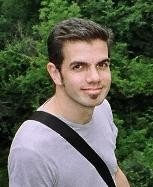
Poem by Alex Boyd

Eyewear is pleased to welcome Toronto-based poet Alex Boyd to its weekly Friday spot.

Boyd studied at Brock University and graduated with a BA in English. In 2000 he moved to live in Scotland, but now lives and works in Toronto again. While writing, he has worked for Chapters, the City of Toronto, the National Ballet and the federal government.

He is the author of poems, fiction, reviews and essays, and has had work published in magazines and newspapers such as Taddle Creek, Books in Canada, The Globe and Mail, Quill and Quire and on various sites such as The Danforth Review.

In May of 2003 he inherited the well-regarded (and some would say infamous) IV lounge reading series from poet Paul Vermeersch, and as a result is currently booking and hosting the series. Boyd is a member of Greenpeace and PEN Canada.

He is a founder editor of the new online journal, Northern Poetry Review (see Links) which I recommend, even in its infancy.


The Baker Signed Up, 1914

When he stumbles in the trench
his hands cut into mud like dough.
Surrounded by puddles, rats, lice.

Helping carry wounded along wooden
planks because the mud is deep
enough to swallow a man,
he pictures it baked in the sun, hard.

He skips, sometimes, around shell
casings, oven hot and tumbling
from the back of a spent gun.

Under the familiar whistle of
falling bombs that softened
and pounded earth, he slept,
while explosions sliced at the edges
of his dreams: the song of chimes
above the door, the smell of fresh bread,
a Chelsea bun with icing dropped
into a paper bag and handed
over the counter.

poem by Alex Boyd
first published in the pamphlet Brick and Bone, available at www.alexboyd.com

Comments

Popular posts from this blog

A  poem for my mother, July 15 When she was dying And I was in a different country I dreamt I was there with her Flying over the ocean very quickly, And arriving in the room like a dream And I was a dream, but the meaning was more Than a dream has – it was a moving over time And land, over water, to get love across Fast enough, to be there, before she died, To lean over the small, huddled figure, In the dark, and without bothering her Even with apologies, and be a kiss in the air, A dream of a kiss, or even less, the thought of one, And when I woke, none of this had happened, She was still far distant, and we had not spoken.

Poetry vs. Literature

Poetry is, of course, a part of literature. But, increasingly, over the 20th century, it has become marginalised - and, famously, has less of an audience than "before". I think that, when one considers the sort of criticism levelled against Seamus Heaney and "mainstream poetry", by poet-critics like Jeffrey Side , one ought to see the wider context for poetry in the "Anglo-Saxon" world. This phrase was used by one of the UK's leading literary cultural figures, in a private conversation recently, when they spoke eloquently about the supremacy of "Anglo-Saxon novels" and their impressive command of narrative. My heart sank as I listened, for what became clear to me, in a flash, is that nothing has changed since Victorian England (for some in the literary establishment). Britain (now allied to America) and the English language with its marvellous fiction machine, still rule the waves. I personally find this an uncomfortable position - but when ...

IQ AND THE POETS - ARE YOU SMART?

When you open your mouth to speak, are you smart?  A funny question from a great song, but also, a good one, when it comes to poets, and poetry. We tend to have a very ambiguous view of intelligence in poetry, one that I'd say is dysfunctional.  Basically, it goes like this: once you are safely dead, it no longer matters how smart you were.  For instance, Auden was smarter than Yeats , but most would still say Yeats is the finer poet; Eliot is clearly highly intelligent, but how much of Larkin 's work required a high IQ?  Meanwhile, poets while alive tend to be celebrated if they are deemed intelligent: Anne Carson, Geoffrey Hill , and Jorie Graham , are all, clearly, very intelligent people, aside from their work as poets.  But who reads Marianne Moore now, or Robert Lowell , smart poets? Or, Pound ?  How smart could Pound be with his madcap views? Less intelligent poets are often more popular.  John Betjeman was not a very smart poet, per se....