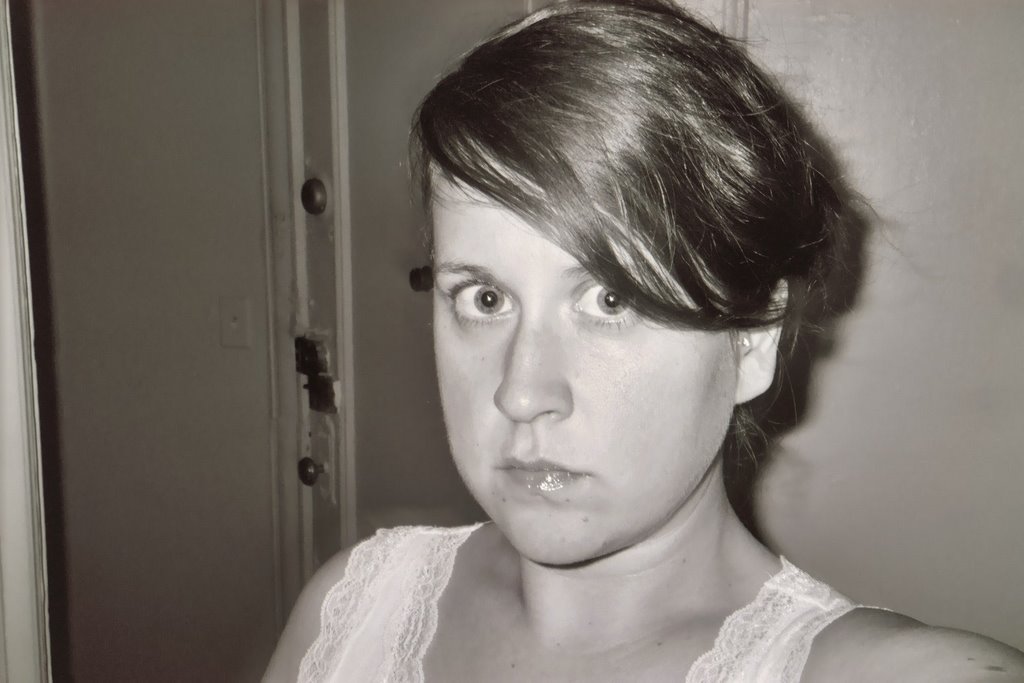
Poem by Jenna Cardinale

Eyewear is pleased to welcome Jenna Cardinale (pictured) to its Friday Feature.

Cardinale is the author of Journals (Whole Coconut, 2006). Her sonnets have appeared in Court Green, Blue Mesa Review, Coconut and Dusie, among other journals.

She lives in New York, where she teaches poetry writing at Lehman College and Explorations Academy, an experimental public high school.


She's Only Willing to Remember the War on Her Birthday


I am going on cleaning the weeds
off the terrace
so when the American army gets here
it can sit and then cough comfortably
on it. They will be tan,
the fatigues,
or another shade of tired.

Must we wear ribbons, glue
our thick brown blood
to wallpaper.

Will a baby
be sired
as part of the decorations.

Soft mud over old
mud is preferred.
I'll see it coming
in the house,
down the hall. It's like a city
on a hill that can't hide.
Sit, I'll say and call him by
a name like Mike.

Now I hang tarps of washed love
that are not flags
and bury the fruits
which will soon rot.

poem by Jenna Cardinale

Comments

Popular posts from this blog

A  poem for my mother, July 15 When she was dying And I was in a different country I dreamt I was there with her Flying over the ocean very quickly, And arriving in the room like a dream And I was a dream, but the meaning was more Than a dream has – it was a moving over time And land, over water, to get love across Fast enough, to be there, before she died, To lean over the small, huddled figure, In the dark, and without bothering her Even with apologies, and be a kiss in the air, A dream of a kiss, or even less, the thought of one, And when I woke, none of this had happened, She was still far distant, and we had not spoken.

Poetry vs. Literature

Poetry is, of course, a part of literature. But, increasingly, over the 20th century, it has become marginalised - and, famously, has less of an audience than "before". I think that, when one considers the sort of criticism levelled against Seamus Heaney and "mainstream poetry", by poet-critics like Jeffrey Side , one ought to see the wider context for poetry in the "Anglo-Saxon" world. This phrase was used by one of the UK's leading literary cultural figures, in a private conversation recently, when they spoke eloquently about the supremacy of "Anglo-Saxon novels" and their impressive command of narrative. My heart sank as I listened, for what became clear to me, in a flash, is that nothing has changed since Victorian England (for some in the literary establishment). Britain (now allied to America) and the English language with its marvellous fiction machine, still rule the waves. I personally find this an uncomfortable position - but when ...

IQ AND THE POETS - ARE YOU SMART?

When you open your mouth to speak, are you smart?  A funny question from a great song, but also, a good one, when it comes to poets, and poetry. We tend to have a very ambiguous view of intelligence in poetry, one that I'd say is dysfunctional.  Basically, it goes like this: once you are safely dead, it no longer matters how smart you were.  For instance, Auden was smarter than Yeats , but most would still say Yeats is the finer poet; Eliot is clearly highly intelligent, but how much of Larkin 's work required a high IQ?  Meanwhile, poets while alive tend to be celebrated if they are deemed intelligent: Anne Carson, Geoffrey Hill , and Jorie Graham , are all, clearly, very intelligent people, aside from their work as poets.  But who reads Marianne Moore now, or Robert Lowell , smart poets? Or, Pound ?  How smart could Pound be with his madcap views? Less intelligent poets are often more popular.  John Betjeman was not a very smart poet, per se....