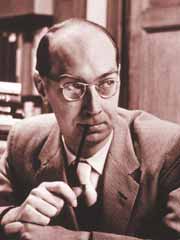
 Philip Larkin, pictured above, one of England's greatest poets since Hardy, and arguably, after Empson, the least in terms of actual output, has come back from the grave - just in time for a new ban (this time not on Lady Chatterley but cigarettes in pubs) - in the form of voice recordings found in a desolate attic. I have an image of someone bursting in.
At any rate, this is jolly good news, and I can't wait to hear them. I have always had a Larkin fetish (I say fetish because it is slightly seedy to adore Larkin's work as much as I do. I like the fact he published collections spaced about a decade apart - '45, '55, '64, '74, and each one of them was arguably the most exciting book of their decade).
I'll have to figure out a way to get one for Oxfam, too, come to think of it...
In the meantime, here's the article from The Telegraph:
Unknown Larkin tapes found in attic
By Chris Hastings (Filed: 12/02/2006)
Unheard tapes of Philip Larkin reading some of his most famous works have been found in the attic of one of his closest friends.
The discovery of the recordings, made by Larkin in a makeshift studio in 1980, are being hailed as one of the most significant literary finds in recent years.
On the tapes, Larkin, who refused the title of poet laureate, reads 25 of his favourite poems, including three from his first important collection The North Ship, which was published in 1945.
It had been thought that the poet, who died of throat cancer aged 63 in 1985, never recorded any of the works from this collection.
Larkin also reads selections from The Less Deceived, published in 1955, The Whitsun Weddings, 1964, and High Windows, 1974.
The tapes, which have been authenticated by both the Society of Authors and The Philip Larkin Society, were produced in the converted garage of John Weeks, a former BBC sound engineer who met the poet while they were working at the University of Hull.
Mr Weeks, who died in 1995, made hundreds of tapes about life in the seaside town of Hornsea, near Hull, where he lived.
The Larkin recordings were found after Mr Week's widow Molly asked her son Peter to catalogue the collection. "I knew my father knew Larkin but I had no idea about the tapes. I am sure they have never been heard outside the garage," he said.
Andrew Motion, the poet laureate, who is one of Larkin's literary executors, welcomed the discovery. He said: "I didn't realise he had made any recordings from The North Ship so this is a significant find."
Comments