Historic Recording for Oxfam

On Friday, February 24, the largest single gathering of famous and popular British and Irish poets for one recording session occured - with readings for an Oxfam CD, and a Talking Book for the blind. The event was conceived and planned by me, with the support of Martin Penny and Su Lycett of Oxfam, and help on the day from New York writer Thaddeus Rutkowski.

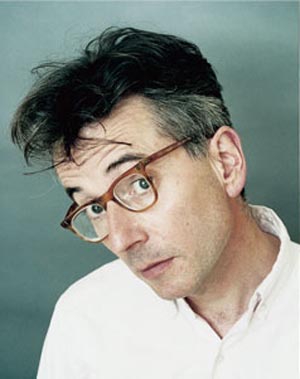
The day was mostly a huge success - from mad-genius John Hegley (pictured here) bringing along his tuba-playing partner, to legends Al Alvarez, Dannie Abse and Alan Brownjohn reuniting after decades, to young rising stars like Nick Laird, Owen Sheers, Annie Freud and Patience Agbabi performing their fresh new work.

The assembled poets agreed it was the most impressive single gathering of poets in one room for a recording in British poetry's history.

The 52 poets in attendance - including Wendy Cope, George Szirtes, Pam Ayres, Eric Ormsby, Jo Shapcott, Jamie McKendrick, Helen Farish, David Harsent, Sophie Hannah, Alan Jenkins, and many many more - who came from across the UK, and some as far as Italy and Galway for the day, spilled out into the usually quiet, calm halls of the Royal National Institute for the Blind's Camden Talking Books state-of-the-art recording studio, and recorded over 100 poems in a frenzied marathon between 10 am-5 pm, in two very busy studios.

One engineer, Dale, said it "was mad" to bring so many talents in on one day. Poet Laureate Andrew Motion read his masterpiece on visiting Anne Frank's House, and Mario Petrucci read a new poem written especially for the day.

Comments

Popular posts from this blog

A  poem for my mother, July 15 When she was dying And I was in a different country I dreamt I was there with her Flying over the ocean very quickly, And arriving in the room like a dream And I was a dream, but the meaning was more Than a dream has – it was a moving over time And land, over water, to get love across Fast enough, to be there, before she died, To lean over the small, huddled figure, In the dark, and without bothering her Even with apologies, and be a kiss in the air, A dream of a kiss, or even less, the thought of one, And when I woke, none of this had happened, She was still far distant, and we had not spoken.

Poetry vs. Literature

Poetry is, of course, a part of literature. But, increasingly, over the 20th century, it has become marginalised - and, famously, has less of an audience than "before". I think that, when one considers the sort of criticism levelled against Seamus Heaney and "mainstream poetry", by poet-critics like Jeffrey Side , one ought to see the wider context for poetry in the "Anglo-Saxon" world. This phrase was used by one of the UK's leading literary cultural figures, in a private conversation recently, when they spoke eloquently about the supremacy of "Anglo-Saxon novels" and their impressive command of narrative. My heart sank as I listened, for what became clear to me, in a flash, is that nothing has changed since Victorian England (for some in the literary establishment). Britain (now allied to America) and the English language with its marvellous fiction machine, still rule the waves. I personally find this an uncomfortable position - but when ...

IQ AND THE POETS - ARE YOU SMART?

When you open your mouth to speak, are you smart?  A funny question from a great song, but also, a good one, when it comes to poets, and poetry. We tend to have a very ambiguous view of intelligence in poetry, one that I'd say is dysfunctional.  Basically, it goes like this: once you are safely dead, it no longer matters how smart you were.  For instance, Auden was smarter than Yeats , but most would still say Yeats is the finer poet; Eliot is clearly highly intelligent, but how much of Larkin 's work required a high IQ?  Meanwhile, poets while alive tend to be celebrated if they are deemed intelligent: Anne Carson, Geoffrey Hill , and Jorie Graham , are all, clearly, very intelligent people, aside from their work as poets.  But who reads Marianne Moore now, or Robert Lowell , smart poets? Or, Pound ?  How smart could Pound be with his madcap views? Less intelligent poets are often more popular.  John Betjeman was not a very smart poet, per se....