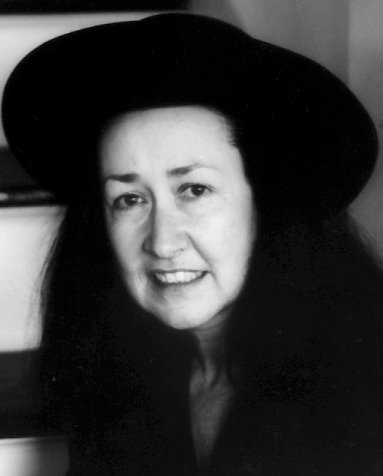
Poem by Dara Wier

Eyewear is very glad to feature, this Friday, July 4th, the American poet Dara Wier (see photo).

Wier's books include Reverse Rapture (Verse Press, 2005), Hat On A Pond (Verse Press, 2003), Voyages In English (Carnegie-Mellon, 2000), Our Master Plan (Carnegie-Mellon, 1997), Blue For The Plough (Carnegie-Mellon, 1992), The Book Of Knowledge (Carnegie-Mellon, 1988), All You Have In Common (Carnegie-Mellon, 1984), The 8-Step Grapevine (Carnegie-Mellon, 1980), and Blood, Hook & Eye (University of Texas, 1977).

Her limited editions include Fly On The Wall (Oat City Press, 1996) and The Lost Epic (co-written with James Tate, Waiting for Godot Books, 1999).

Her work has been featured in Best American Poetry, American Poetry Review, Conduit, Fence, Verse, Green Mountain Review, New American Writing, Volt, and Denver Quarterly.

Wier directs the MFA program for poets and writers for the University of Massachusetts in Amherst and, with Noy Holland and Lisa Olstein, co-ordinates the Juniper Initiative for literary arts and action. She is the recipient of fellowships from the Guggenheim Foundation and the National Endowment for the Arts.


Without You

You know that famous silence out beyond the stars

We’ve imported it here where it shies in shimmers

Like a dark horse’s shadow in a snow blown pasture

We pass by there, look here, what’s this my fingers

Are saying to my thumb, you know those famous silent

Skies, hear a twisted engine’s contortions discharging

Ignition ignition , how hard we register a hollow

Thump of a steel door closing, it’s not your civil twilight,

Your altitude of fine immovable patience, in another story

I lied about how wind can get a tree to tell all its secrets,

I lied about an hourglass I was supposed to fill with someone’s ashes,

In twilight anyone can be thinking about airlines,

I wondered if an hourglass filled with someone’s ashes

Might tell me something, strangely, we have hourglasses.


poem by Dara Wier

Comments

Popular posts from this blog

A  poem for my mother, July 15 When she was dying And I was in a different country I dreamt I was there with her Flying over the ocean very quickly, And arriving in the room like a dream And I was a dream, but the meaning was more Than a dream has – it was a moving over time And land, over water, to get love across Fast enough, to be there, before she died, To lean over the small, huddled figure, In the dark, and without bothering her Even with apologies, and be a kiss in the air, A dream of a kiss, or even less, the thought of one, And when I woke, none of this had happened, She was still far distant, and we had not spoken.

Poetry vs. Literature

Poetry is, of course, a part of literature. But, increasingly, over the 20th century, it has become marginalised - and, famously, has less of an audience than "before". I think that, when one considers the sort of criticism levelled against Seamus Heaney and "mainstream poetry", by poet-critics like Jeffrey Side , one ought to see the wider context for poetry in the "Anglo-Saxon" world. This phrase was used by one of the UK's leading literary cultural figures, in a private conversation recently, when they spoke eloquently about the supremacy of "Anglo-Saxon novels" and their impressive command of narrative. My heart sank as I listened, for what became clear to me, in a flash, is that nothing has changed since Victorian England (for some in the literary establishment). Britain (now allied to America) and the English language with its marvellous fiction machine, still rule the waves. I personally find this an uncomfortable position - but when ...

IQ AND THE POETS - ARE YOU SMART?

When you open your mouth to speak, are you smart?  A funny question from a great song, but also, a good one, when it comes to poets, and poetry. We tend to have a very ambiguous view of intelligence in poetry, one that I'd say is dysfunctional.  Basically, it goes like this: once you are safely dead, it no longer matters how smart you were.  For instance, Auden was smarter than Yeats , but most would still say Yeats is the finer poet; Eliot is clearly highly intelligent, but how much of Larkin 's work required a high IQ?  Meanwhile, poets while alive tend to be celebrated if they are deemed intelligent: Anne Carson, Geoffrey Hill , and Jorie Graham , are all, clearly, very intelligent people, aside from their work as poets.  But who reads Marianne Moore now, or Robert Lowell , smart poets? Or, Pound ?  How smart could Pound be with his madcap views? Less intelligent poets are often more popular.  John Betjeman was not a very smart poet, per se....