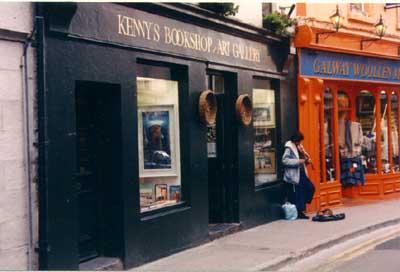
Kennys Is Going, Now The Waste Land

Kennys Bookstore (to the right) is perhaps the most famous and eccentric independent book shop in Ireland - Brendam Behan read there, along with many other legends (every Irish author worth their salt has read there and some Yanks too) - and now the Galway institution is closing; or what may be worse, going all virtual.

I read at Kennys for the launch of one of my recent collections (the pints after blur the memory) - actually, it was, oddly, the day after my wedding. Flushed and well-dressed, I read for a good crowd.

Mr. Kenny himself sat there puffed up in a three-pice suit at a huge desk in the middle of one of the rooms where books were on sale - slitting open letters with a pen-knife and gruffly answering the old black phone as browsers shifted around him, like some Kubla Kane of Books.

I found a copy of Map-Maker's Colours, the first anthology I co-edited, when I was 19-20, with the Belfast poet Martin Mooney. The reading was fun - read with Kevin Higgins.

My photo was taken for the walls - those famous walls adorned with the photos of the great and the good in the literary world. I had hoped to have more than two years of infamy on that wall, which now comes, allegorically, down like those at Jericho. I wonder if the photos of Behan and Co. will go virtual, too?

In the meantime, we need to panic. If all such independents disappear, the waste land that will come after will not be suited to the life of poets and writers, who like the wine and cheese served in such places.

Comments

Popular posts from this blog

A  poem for my mother, July 15 When she was dying And I was in a different country I dreamt I was there with her Flying over the ocean very quickly, And arriving in the room like a dream And I was a dream, but the meaning was more Than a dream has – it was a moving over time And land, over water, to get love across Fast enough, to be there, before she died, To lean over the small, huddled figure, In the dark, and without bothering her Even with apologies, and be a kiss in the air, A dream of a kiss, or even less, the thought of one, And when I woke, none of this had happened, She was still far distant, and we had not spoken.

Poetry vs. Literature

Poetry is, of course, a part of literature. But, increasingly, over the 20th century, it has become marginalised - and, famously, has less of an audience than "before". I think that, when one considers the sort of criticism levelled against Seamus Heaney and "mainstream poetry", by poet-critics like Jeffrey Side , one ought to see the wider context for poetry in the "Anglo-Saxon" world. This phrase was used by one of the UK's leading literary cultural figures, in a private conversation recently, when they spoke eloquently about the supremacy of "Anglo-Saxon novels" and their impressive command of narrative. My heart sank as I listened, for what became clear to me, in a flash, is that nothing has changed since Victorian England (for some in the literary establishment). Britain (now allied to America) and the English language with its marvellous fiction machine, still rule the waves. I personally find this an uncomfortable position - but when ...

IQ AND THE POETS - ARE YOU SMART?

When you open your mouth to speak, are you smart?  A funny question from a great song, but also, a good one, when it comes to poets, and poetry. We tend to have a very ambiguous view of intelligence in poetry, one that I'd say is dysfunctional.  Basically, it goes like this: once you are safely dead, it no longer matters how smart you were.  For instance, Auden was smarter than Yeats , but most would still say Yeats is the finer poet; Eliot is clearly highly intelligent, but how much of Larkin 's work required a high IQ?  Meanwhile, poets while alive tend to be celebrated if they are deemed intelligent: Anne Carson, Geoffrey Hill , and Jorie Graham , are all, clearly, very intelligent people, aside from their work as poets.  But who reads Marianne Moore now, or Robert Lowell , smart poets? Or, Pound ?  How smart could Pound be with his madcap views? Less intelligent poets are often more popular.  John Betjeman was not a very smart poet, per se....