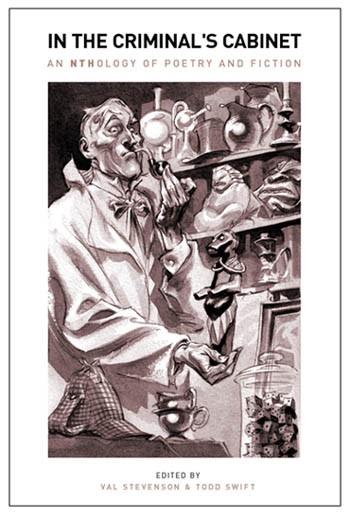
In The Criminal's Cabinet

I often wonder what's going on with the wide world of poetry - and how despite the best efforts of many hard-working poetry activists, editors and so on there is the same sort of apathy we associate with high school election speeches.

Basically: is there really a global poetry community that is aware of its constitutent members, and works hard to locate, cultivate, and support them and their works? Maybe not.

Take, for example - or Exhibit A, if you will - a recent (late 2004) global English-language Internet-driven anthology of mostly avant-garde or at least indie poetry and prose edited by myself and Val Stevenson (see Nthposition link to order): In The Criminal's Cabinet.

So, very few mainstream reviews, and not that many sales so far. But consider some of the poets included - and the fact that it represents very new poetry, all written between 2002-2004:

Robert Allen, Tammy Armstrong, Louise Bak, Charles Bernstein, bill bissett, Stephanie Bolster, Jason Camlot, Maxine Chernoff, Todd Colby, MTC Cronin, Jennifer K Dick, Isobel Dixon, Peter Finch, Brentley Frazer, Philip Fried, Ethan Gilsdorf, Giles Goodland, Daphne Gottlieb, Jen Hadfield, Steven Heighton, Kevin Higgins, Paul Hoover, Ranjit Hoskote, Jill Jones, Norman Jope, Jayne Fenton Keane, Roddy Lumsden, Alexis Lykiard, Valeria Melchioretto, Nessa O’Mahony, Richard Peabody, David Prater, Sina Queyras, Srikanth Reddy, Ali Riley, Peter Riley, Thaddeus Rutkowski, Rebecca Seiferle, Ron Silliman, Hal Sirowitz, Sean Street, Rodrigo Toscano, Alison Trower, Paul Vermeersch, John Hartley Williams, and Max Winter (among many others equally fine).

That's a pretty good list eh?

I think this anthology deserves better. I mean, the review in Verse was great, but, other than a few blog mentions, that's been about it. But perhaps it is the fate of small press ventures to generally be swatted away by market-place indifference.

Be that as it may, the book is waiting for those who want to support the grass-roots efforts of sites like Nthposition.

Comments

Popular posts from this blog

A  poem for my mother, July 15 When she was dying And I was in a different country I dreamt I was there with her Flying over the ocean very quickly, And arriving in the room like a dream And I was a dream, but the meaning was more Than a dream has – it was a moving over time And land, over water, to get love across Fast enough, to be there, before she died, To lean over the small, huddled figure, In the dark, and without bothering her Even with apologies, and be a kiss in the air, A dream of a kiss, or even less, the thought of one, And when I woke, none of this had happened, She was still far distant, and we had not spoken.

Poetry vs. Literature

Poetry is, of course, a part of literature. But, increasingly, over the 20th century, it has become marginalised - and, famously, has less of an audience than "before". I think that, when one considers the sort of criticism levelled against Seamus Heaney and "mainstream poetry", by poet-critics like Jeffrey Side , one ought to see the wider context for poetry in the "Anglo-Saxon" world. This phrase was used by one of the UK's leading literary cultural figures, in a private conversation recently, when they spoke eloquently about the supremacy of "Anglo-Saxon novels" and their impressive command of narrative. My heart sank as I listened, for what became clear to me, in a flash, is that nothing has changed since Victorian England (for some in the literary establishment). Britain (now allied to America) and the English language with its marvellous fiction machine, still rule the waves. I personally find this an uncomfortable position - but when ...

IQ AND THE POETS - ARE YOU SMART?

When you open your mouth to speak, are you smart?  A funny question from a great song, but also, a good one, when it comes to poets, and poetry. We tend to have a very ambiguous view of intelligence in poetry, one that I'd say is dysfunctional.  Basically, it goes like this: once you are safely dead, it no longer matters how smart you were.  For instance, Auden was smarter than Yeats , but most would still say Yeats is the finer poet; Eliot is clearly highly intelligent, but how much of Larkin 's work required a high IQ?  Meanwhile, poets while alive tend to be celebrated if they are deemed intelligent: Anne Carson, Geoffrey Hill , and Jorie Graham , are all, clearly, very intelligent people, aside from their work as poets.  But who reads Marianne Moore now, or Robert Lowell , smart poets? Or, Pound ?  How smart could Pound be with his madcap views? Less intelligent poets are often more popular.  John Betjeman was not a very smart poet, per se....